
Common Misconceptions in the Production of Flame-Retardant Cable Trays:
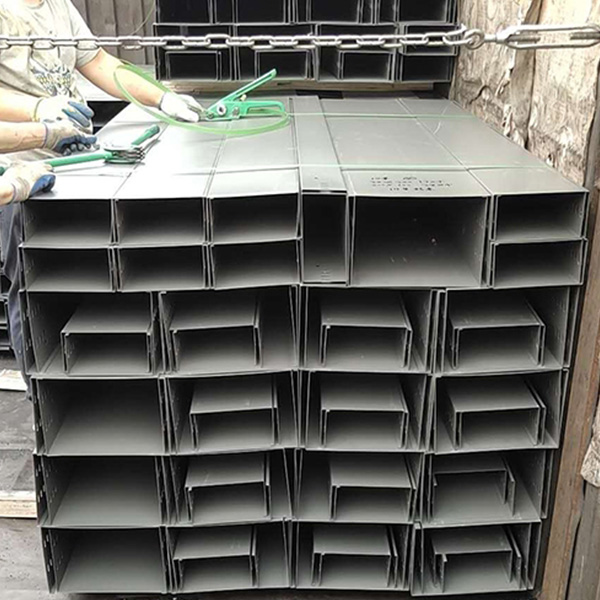
Focusing only on appearance while ignoring internal performance data; high-alkali products are often well-disguised.
Emphasizing thickness over intrinsic quality, or sand content over the bonding between resin and sand—while the latter is the key to quality. High-quality foreign products contain 2/3 sand with excellent bonding, as sand enhances rigidity.
Blindly assuming that sand-free FRP profiles are of better quality. In fact, the use of sand depends on application requirements. Products with poor rigidity cannot meet operational needs. While high prices may indicate qualified materials, they can also lead to unnecessary waste. However, unscrupulous manufacturers still add various additives or use high-alkali fibers to pass off inferior products as high-quality.
Identifying Qualified Materials
Among counterfeit and shoddy products, high-alkali glass fiber materials are particularly harmful. High-alkali materials are soluble in water; FRP profiles used in special geological conditions or humid soil will quickly deteriorate and decompose, causing significant hazards during later use.
Hebei Cable Tray Manufacturers introduce the following methods to distinguish high-alkali glass fiber products:
High-alkali glass fiber is often brittle and prone to breaking.
When pressing or striking FRP profiles with a heavy object or hammer, those made of high-alkali fiber will break at the cross-section with no fiber adhesion, leaving a clean cut.
Distinguishing the Quality of FRP Cable Trays and Their Installation Steps
1. Drilling Installation Holes
According to construction requirements and installation positions, drill bracket positioning holes on the wall.
2. Bracket Installation
Fix the cable brackets to the wall using M12 expansion bolts.
Gaskets must be installed between the bolts and brackets, and the brackets must fit tightly against the wall to prevent loosening.
3. Cable Placement
Lay cables on the brackets, placing heavier cables as close to the root of the brackets as possible.
Secure the cables firmly with ties.
Do not drop cables from heights during laying; place them gently on the brackets.
4. Construction Precautions for Laying and Maintenance
For integrated cable brackets: Do not pull cables directly on the brackets during laying or maintenance. Take effective measures to avoid lateral forces on the brackets.
For ladder-type cable trays: Suitable for laying large-diameter cables, especially high and low-voltage power cables.
When adjusting cables at certain intervals:
Drag the cables as close to the root of the brackets as possible.
Or lift the cables to be adjusted between brackets and apply force slowly to avoid overloading the brackets.
This website uses cookies to ensure you get the best experience on our website.

 Español
 Portugues
 Pусский
 العربية



 WhatsApp
 Phone
Phone E-mail
Comment
(0)