
To understand the differences between cable trays and cable trunking, cable tray manufacturers first need to clarify their definitions in detail:
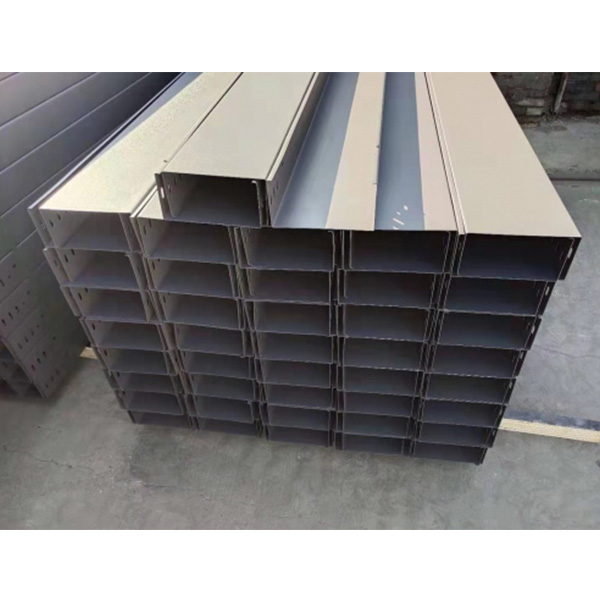
1. About Cable Trays
Cable trays are available in channel-type, tray-type, ladder-type, and mesh structures. Composed of supports, arms, and installation accessories, they can be independently installed or attached to various buildings (structures) and pipe gallery supports. Featuring a simple structure, aesthetic appearance, flexible configuration, and convenient maintenance, all components require galvanization—especially for trays installed outdoors exposed to the elements. For applications near the ocean or in corrosive environments, materials must possess physical properties such as corrosion resistance, moisture resistance, strong adhesion, and high impact strength. Essentially, a cable tray is a support structure designed for supporting and routing cables.
Widely used in engineering projects, cable trays are indispensable for cable laying. As a supporting item in wiring projects, there is currently no dedicated specification for guidance, and the specifications and models from different manufacturers lack universality. Therefore, during the design and selection process, suitable cable trays should be reasonably chosen based on the type and quantity of cables in various weak current systems. Cable trays offer advantages including a complete product range, wide applicability, high strength, lightweight structure, low cost, simple construction, flexible wiring, standardized installation, and an attractive appearance.
Classification of Cable Trays:
Ladder-type cable trays
Tray-type cable trays
Channel-type cable trays
2. About Cable Trunking
Cable trunking (also known as wiring trunking, cable duct, or wire trough, depending on regional terminology) is an electrical fixture used to neatly organize and secure power cables, data cables, and other wires on walls or ceilings. Generally available in plastic or metal materials, each type serves different purposes.
Classification of Cable Trunking:Insulated cable trunking, snap-open cable trunking, mini cable trunking, divided cable trunking, interior decoration cable trunking, integrated insulated cable trunking, telephone cable trunking, Japanese-style telephone cable trunking, exposed wire trunking, circular cable conduit, exhibition partition cable trunking, circular floor cable trunking, flexible circular floor cable trunking, covered cable trunking, etc.
Based on material differences, cable trunking can be divided into various types. Commonly used ones include:
Environmentally friendly PVC cable trunking
Halogen-free PPO cable trunking
Halogen-free PC/ABS cable trunking
Metal cable trunking (steel, aluminum, etc.)
Characteristics of Cable Trunking:Suitable for long-span installation, extremely easy to install, highly safe and reliable, flexible wiring, and strong interchangeability.
This website uses cookies to ensure you get the best experience on our website.

 Español
 Portugues
 Pусский
 العربية



 WhatsApp
 Phone
Phone E-mail
Comment
(0)