
In harsh corrosive environments, channel cable trays provide excellent shielding and protection for cables. As a fully enclosed type of cable tray, they are suitable for high-sensitivity systems such as control cables, instrumentation cables, and thermocouple cables.
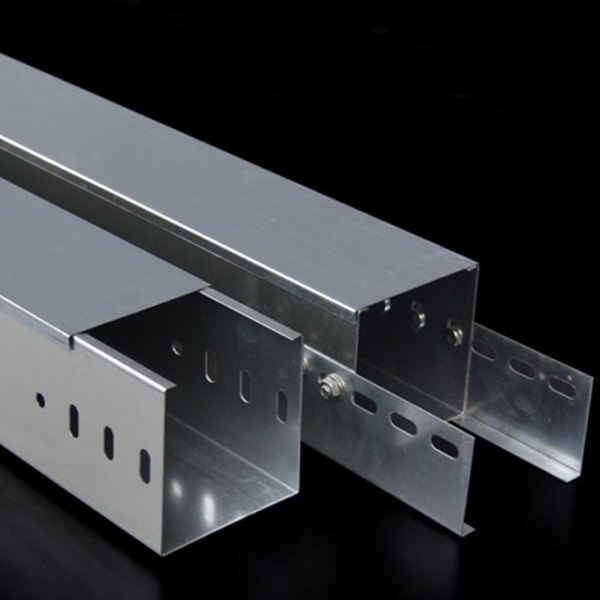
Tray cable trays are widely used in industries including petroleum, petrochemicals, light industry, television, and telecommunications. Featuring light weight, high load-bearing capacity, an aesthetic appearance, a simple structure, and easy installation, they are suitable for both power cable installation and control cable laying. The surface treatment of tray cable trays can be divided into electroplating and painting; special anti-corrosion treatment is available for severely corrosive environments. Tray cable trays can be equipped with protective covers—when enclosures are required, specifications can be specified based on cover models. All accessories are compatible with both tray and channel cable trays.
What Are the Differences Between Channel Cable Trays and Ladder Cable Trays?
Generally speaking, channel cable trays are mainly used for laying a large number of small-diameter wires and cables, while tray cable trays are primarily designed for laying cables with large cross-sections. Currently, the structural types of cable trays can be classified into: perforated trays, non-perforated trays, ladders, and modular trays.
Perforated Trays: Composed of grooved sections with perforated bottom plates and side plates, or formed by punching holes in a single sheet of metal.
Non-Perforated Trays: Grooved components with closed bottom plates and side plates (equivalent to channel cable trays).
Ladder Trays: Trapezoidal components consisting of side rails and numerous transverse rungs.
Modular Trays: Assembled components that can be combined freely using perforated modules to adapt to construction site requirements.
When cable trays are used for laying both low-voltage power cables and control cables in the same tray or ladder, a partition shall be installed in the middle to separate them.
This website uses cookies to ensure you get the best experience on our website.

 Español
 Portugues
 Pусский
 العربية



 WhatsApp
 Phone
Phone E-mail
Comment
(0)