
Cable trays have been used in China for only over a decade, while in developed countries like Europe and the United States, their application dates back several decades. In a computer room project, compared to expensive high-tech software and hardware, cable trays are relatively simple and rarely receive much attention. However, they are an indispensable part of the entire wiring project.
General Provisions
This chapter applies to the installation of cable trays and cable laying in general industrial and civil buildings with a voltage of 10KV and below. As a supporting project for wiring engineering, there is currently no dedicated standard for guidance, and the specifications and procedures of various manufacturers lack universality. Therefore, during the design and selection process, suitable cable trays should be reasonably selected based on the type and quantity of cables in the weak current system.
Hebei Cable Tray Manufacturers Introduce: Route Determination
Determine the route of the cable tray based on the architectural floor plan, combined with the layout of air conditioning pipelines and electrical pipelines, maintenance accessibility, and the density of cable routes. Indoors, erect the tray along the building's walls, columns, beams, and floor slabs as much as possible. For example, when using an integrated pipe gallery for erection, the tray shall be installed parallel to one side or above the pipelines. Consider down conductors and branch lines to avoid crossings as much as possible. If no other pipe supports are available for reuse, independent columns or supports shall be installed.
Load Calculation
Calculate the weight of cables per unit length on the longitudinal section of the main cable tray.
Do You Know the Installation Process and Specifications of Cable Trays?
Width Determination
Determine the model and specification of the cable tray, the length of support arms, the length and spacing of columns, as well as the width and number of layers of the tray, based on the number of cables, cable diameter, and cable spacing.
Installation Method Determination
Determine the fixing method of the tray according to on-site conditions, such as suspended type, vertical type, side wall-mounted type, or mixed type. Connectors and fasteners are generally supplied as matching components. In addition, select the corresponding cover plate according to the tray structure.
Drawing and Material List Preparation
Draw the plan and section views of the cable tray; isometric views shall also be drawn for local parts. Prepare a bill of materials.
Special Requirements for Combined Use
When used in conjunction with power cable trays, power cables and weak current cables shall be placed on separate sides, separated by a partition in the middle.
When weak current cables are used in the same tray with other low-voltage cables, strictly select weak current cables with an outer shielding layer for the weak current system to avoid mutual interference.
Construction Compliance
The installation of cable trays and cable laying in the trays shall be carried out in accordance with the approved design documents.
Definition of Cable Trays
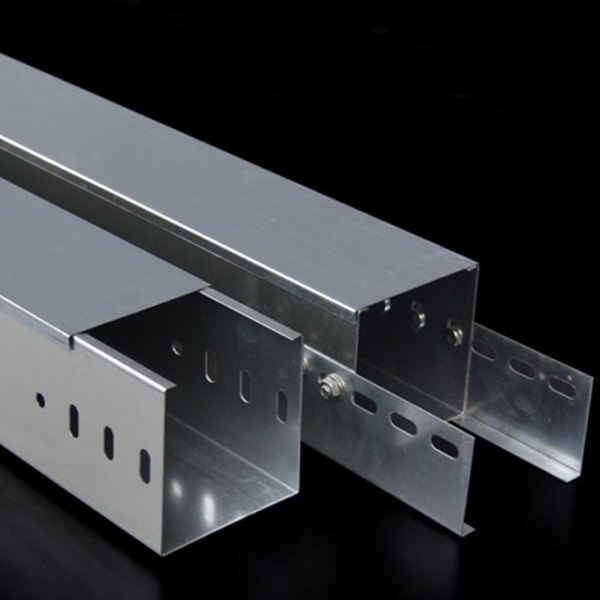
A cable tray refers to a rigid structural system with continuous cable-laying capability, composed of straight sections, curved non-straight sections of trays (troughs) or ladders supported by supports, hangers, and brackets.
This website uses cookies to ensure you get the best experience on our website.

 Español
 Portugues
 Pусский
 العربية



 WhatsApp
 Phone
Phone E-mail
Comment
(0)